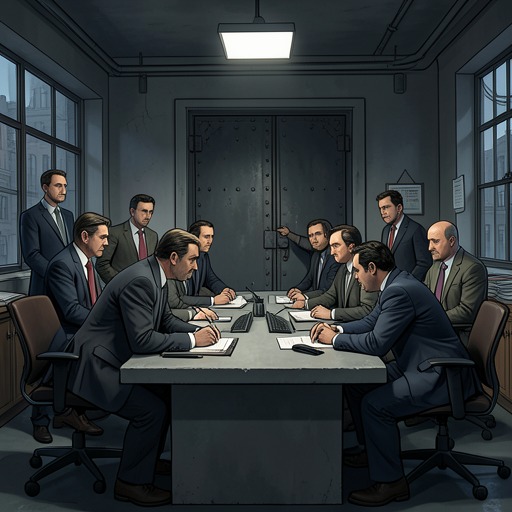
Washington Post rule against naming confidential sources
All the President's MenThe Washington Post rule against naming confidential sources made anonymity a newsroom commitment, not a privilege reporters could casually withdraw when a story came under attack. Its clearest test came when the paper questioned whether a damaging report was accurate: rather than identify sources to defend themselves, the reporters were told that the paper did not name its sources. The rule protected the conditions under which confidential reporting could be gathered, while leaving the newsroom responsible for checking and correcting what it published.
The Rule in Practice
The commitment was visible in the way editors reviewed sensitive reporting. When Ben Bradlee asked Bob Woodward and Carl Bernstein how their stories had been assembled, he wanted to understand the sources’ positions and whether the reporters trusted their information. The discussion established a boundary: Bradlee could satisfy his editorial responsibilities without learning identities the reporters had promised to keep confidential. The arrangement respected both the editor’s need to assess a story and the reporters’ obligations to their sources.
That protection mattered in a newsroom where source relationships were built over repeated contact. Woodward and Bernstein kept separate telephone lists and generally divided their contacts, in part because confidential sources could feel more comfortable developing a relationship with one reporter. The division also reduced the risk that the reporters would interfere with each other’s work. Protecting identities was therefore not merely a response to a particular controversy; it was part of the practical method by which the reporting network was maintained.
Anonymity Under Editorial Pressure
The rule became explicit after a Washington Post report incorrectly identified men as recipients of memoranda that the reporters later concluded were routine security documents, not records of wiretap conversations. The mistake had consequences for the men named in the story, including damage to their reputations and, for one, difficulty finding and keeping employment. As the newsroom tried to establish what had gone wrong, Woodward observed that an agreement with a source might be considered broken if the source had supplied bad information. That possibility did not settle the question for the editors.
Bradlee’s response was categorical about the paper’s practice, even while he acknowledged that the reporters did not yet know whether the account was right or wrong. Naming the sources, he reasoned, would not resolve the dispute: they could deny the information, leaving the paper no further ahead. He rejected making source disclosure the remedy and directed the reporters back toward verification. Bernstein felt relieved; Harry Rosenfeld, though dispirited, proposed returning to the sources and checking the account again. The response kept the burden on the reporting process rather than shifting it onto public identification of the people who had spoken privately.
Verification, Caution, and the Limits of Protection
Source confidentiality operated alongside, but was not identical to, the newsroom’s evidentiary standards. In reporting on money withdrawn from a secret campaign fund, Bob Woodward and Carl Bernstein had information from Deep Throat that the withdrawals financed the Watergate bugging, but another source could not confirm that specific claim. Barry Sussman and Harry Rosenfeld chose a more cautious formulation: the money financed broad intelligence-gathering activities against Democrats. An unwritten standard was taking shape that a specific allegation likely to be treated as criminal would not be published without confirmation from two sources. Keeping sources anonymous did not remove the need to test what they said.
The distinction mattered in a political climate of denial and counterattack. Major outlets often ignored The Washington Post’s reporting or concentrated on official rebuttals, while administration figures challenged the paper’s credibility and cast its coverage as politically prejudiced. Yet when a nationwide sabotage story went out over the Washington Post–Los Angeles Times News Service wire, more than half of its 220 domestic subscribers used it, and coverage beyond the wire’s subscribers was broad. Confidentiality could help sustain the reporting that produced such accounts, but it could not by itself determine whether other news organizations or the public would accept them.
Significance and Tension
The rule’s force lay in its refusal to treat anonymity as expendable whenever the paper was challenged. Bradlee’s insistence preserved the reporters’ promise even at a moment when the story’s accuracy was uncertain and the newsroom faced pressure to account for its claims. At the same time, the consequences of the erroneous report show why confidentiality could not stand in for careful reporting: people named in a false account bore real costs, and protecting sources did not undo those harms.
The book presents this practice as part of a broader, sometimes uncomfortable process of making Watergate journalism. Editors scrutinized claims, reporters revisited their evidence, and the paper’s methods were tested by competition, public attacks, and mistakes. Howard Simons later described the newsroom’s movement into Watergate coverage as incremental and recalled unease about how the paper had proceeded. Against that background, the no-naming rule was a firm boundary within work whose other boundaries were being tested: source identities remained protected, while the published account still had to withstand verification and, when necessary, correction.